STPMS is an indirect TPMS and has the following advantages compared with direct TPMS:
There is no need to install a pressure sensor, significantly reducing costs.
Integrated with GNSS into a pure software algorithm, no additional hardware is required, minimizing direct costs and completely eliminating the risk of hardware failure.
After being installed in a vehicle and used for sale, there is no need for regular maintenance or hardware replacement, saving users money.
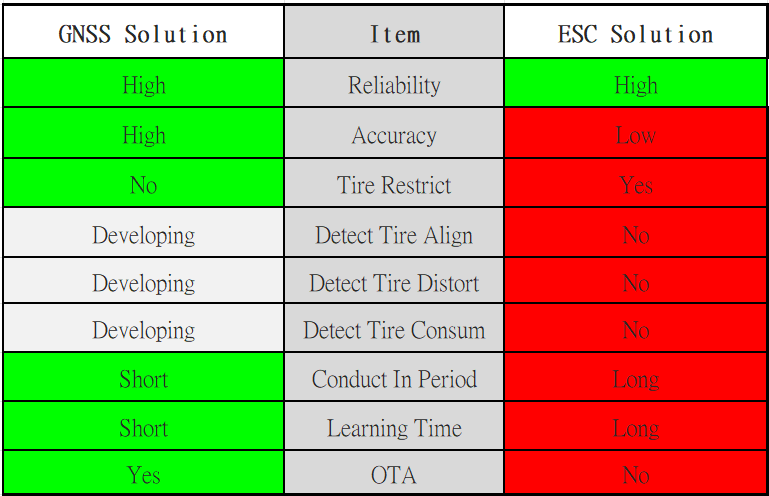
STPMS has the following advantages compared with another ESC indirect iTPMS solution:
The ESC iTPMS operation requires large hardware resources and requires dedicated hardware to implement the algorithm.
The algorithm implementation of STPMS is integrated with the original GNSS hardware environment. It does not require large resources for calculation and does not require additional hardware to implement, making it more reliable.
The algorithm of ESC iTPMS is closely integrated with the driving status of the car, so it takes a long time to be introduced into the car factory to complete mass production, which usually takes nearly half a year.
STPMS is loosely integrated with the characteristics of the car and can be introduced into the car factory to complete mass production in a short period of time. It usually takes one to two months to complete.
The algorithm of ESC iTPMS is closely related to vehicle tires, and the tire model used has certain restrictions, otherwise the alarm accuracy will be affected.
The algorithm of STPMS is not closely related to car tires. Various tires can be freely replaced without restrictions on the use of specific tires.
2. Comparison between STPMS and German Continental AG products
Loading and testing at Dongfeng Motor's designated vehicle proving ground in Xiangyang:
The product of Germany's Continental AG is the indirect ESC iTPMS.
Test items include: normal road (asphalt road, stone road) tire under-pressure test, stone road tire normal and under-pressure test, gravel road tire normal and under-pressure test, normal tire pressure test on working conditions.
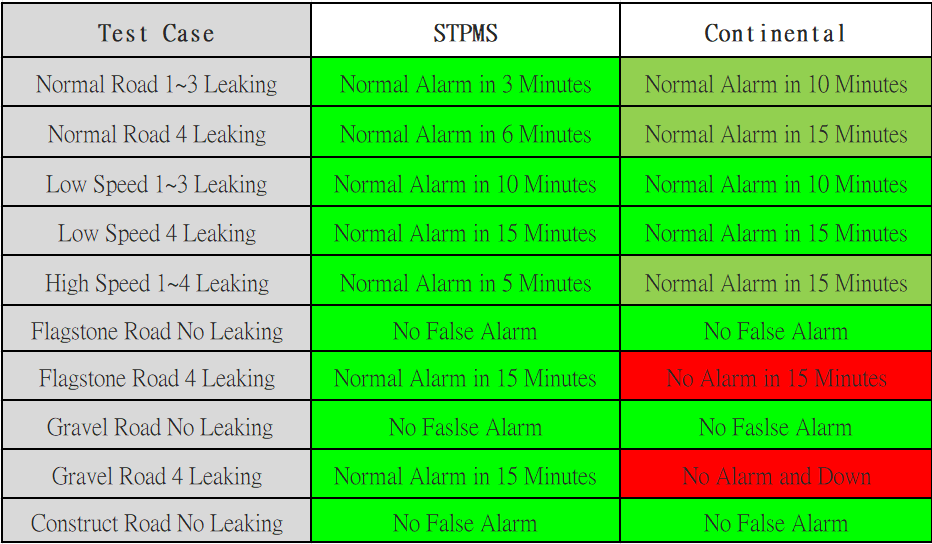
The results of the 1~3 wheel under-pressure test on general roads: STPMS will alarm the tire pressure within 3 minutes, and Continental will alarm within 10 minutes.
General road 4-wheel under-pressure test results: STPMS will alarm the tire pressure within 6 minutes, and Continental will alarm within 15 minutes.
The results of low-speed 1~3 wheel under-pressure test on general roads: STPMS will alarm the tire pressure within 10 minutes, and Continental will alarm within 10 minutes.
Low-speed 4-wheel under-pressure test results on general roads: STPMS will alarm the tire pressure within 15 minutes, and Continental will alarm within 15 minutes.
4-wheel under-pressure test results on Shiban Road: STPMS has a tire pressure alarm within 15 minutes, while Continental has no alarm.
The results of the 4-wheel under-pressure test on a gravel road: the STPMS gave a tire pressure alarm within 15 minutes, but the Continental did not alarm due to a crash.
Test results of running for 30 kilometers with normal tire pressure on working roads: No tire pressure false alarms on STPMS and no alarms on Continental.
The vehicle test results show that STPMS is better than the German Continental iTPMS.
Detailed test results are listed in the following table:
3. How STPMS works
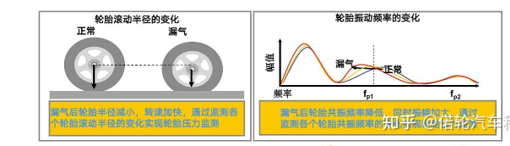
Let’s first talk about the operating principle of ESC’s iTPMS, as shown in the figure below:
Second, under different conditions of tire pressure, the resonance spectrum of the tire will be different. The resonance frequency of the tire when it is leaking will be lower than normal. It can be obtained through the wheel diameter analysis algorithm (Wheel Spectrum Analysis, WSA) Corresponding tire pressure to determine whether the tire is under-inflated. This method can be used to determine under-inflation of multiple tires, but the accuracy is poor.
Combining the algorithms of WRA and WSA can obtain the monitoring of tire pressures from one to four and improve the accuracy, but the overall results still fail to meet the high accuracy requirements.
In the WSA algorithm, the tire speed domain (Time Domain) is converted into the spectrum domain (Frequency Domain), so a large amount of calculation is required, and MCU and DSP hardware must be added to implement the algorithm.
In general: This method solves the problem of judging multiple rounds of undervoltage and greatly reduces the false alarm rate, but it still requires some hardware costs. The duration of multiple rounds of undervoltage alarm is generally still close to the national standard requirement (15 minutes).
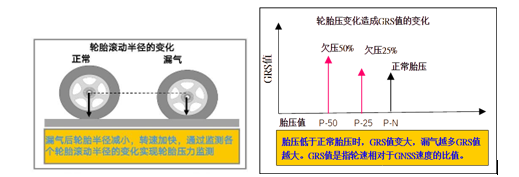
Let’s talk about the operating principle of GNSS STPMS, as shown in the figure below:
First, under different tire pressure conditions, the tire rolling radius will be different. When the tire is deflated, the wheel diameter will be smaller than normal. The corresponding wheel diameter analysis algorithm (Wheel Radius Analysis, WRA) can be used to determine The tire pressure is used to determine whether the tire is under-inflated. This method is generally only suitable for determining the under-inflation of a single tire.
Second, under different conditions of tire pressure, the tire rotation speed will be different relative to the absolute speed of GNSS. When the tire is leaking, the relative rotation speed will be faster than normal. Through the GNSS analysis algorithm (Wheel GNSS Analysis, WGA) ) can obtain the GRS (GNSS Ratio Speed) value and the corresponding tire pressure value to determine whether the tire is under-inflated. This method can be applied to determine the under-pressure of multiple tires with high accuracy.
Combining the algorithms of WRA and WGA can obtain the monitoring of tire pressures from one to four, and using other GNSS data to calculate together, the overall result can meet higher accuracy requirements.
In the WGA algorithm, the tire speed domain and the GNSS speed domain (Time Domain) are used for calculations, so the amount of calculation required is small and no additional MCU or DSP hardware is needed to implement the algorithm.
In general: This method solves the problem of multi-round undervoltage judgment and greatly reduces the false alarm rate, and does not require additional hardware costs (using the original GNSS hardware). The multi-round undervoltage alarm duration can be significantly lower than the national standard requirements ( within 6 minutes).
4. Product features of STPMS
The STPMS product is a pure software solution that calculates tire pressure status based on GNSS data and CAN data. It has the following five characteristics:
STPMS is a pure software algorithm and does not require external hardware, completely eliminating the risk of hardware failure.
STPMS has high accuracy and can issue tire pressure alarms relatively quickly. The single-wheel alarm time is within 3 minutes (the national standard requires within 10 minutes), and the multi-wheel under-pressure alarm time is within 6 minutes (the national standard requires within 15 minutes).
The introduction of STPMS products into car manufacturers does not require hardware modifications, only software updates, which can simplify the certification procedures required by car manufacturers due to configuration changes.
The vehicle-related data required by the STPMS product is loosely combined. The required relevant parameters can be retrieved after a few vehicle test runs, shortening the import time.
STPMS products can continue to develop tire safety-related functions, including tire wear (tread pattern) monitoring, four-wheel alignment monitoring and tire deformation detection, to more comprehensively and effectively prevent risks caused by various tire anomalies.
5. How STPMS integrates sales
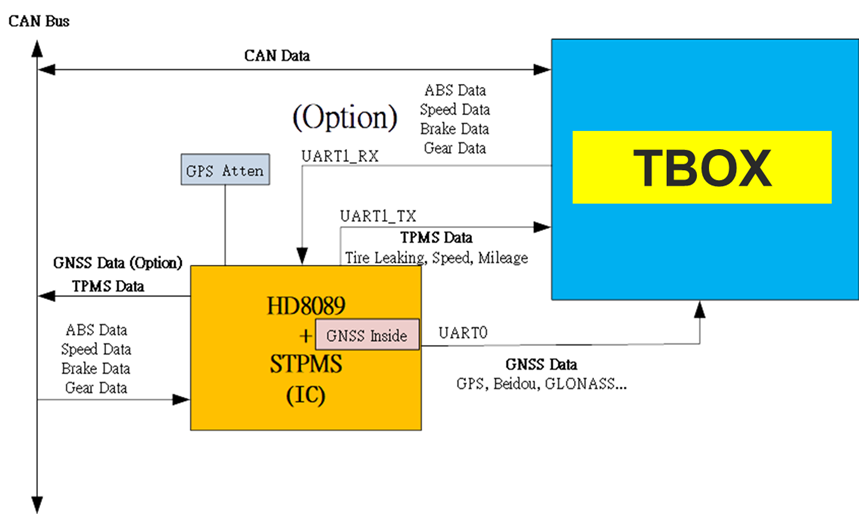
Since the STPMS solution is integrated within the GNSS module, the integrated marketing method with equipment using GNSS modules such as TBox (IVI) must be considered:
The functional integration of STPMS and the car requires the TBox (IVI) software to add three functions: a. Convert the car CAN data to UART data and send it to STPMS. b. Convert STPMS alarm and calibration learning materials from NMEA UART to CAN data and send them to the instrument. c. Cooperate with the execution of OTA remote cloud update software and parameters.
Honghe provides the original program code for the above three functions to TBox (IVI) for software integration. The completion of these three functions requires a small investment of resources and can be completed in about a week.
Although the integration of STPMS and TBox (IVI) is not close, they are closely dependent on each other. When marketing STPMS, we must also consider how to do overall operation and marketing with TBox (IVI).
At present, Honghe has completely implemented the STPMS solution on Huada Beidou's HD8089. Therefore, if the solution introduced to the car factory directly uses HD8089, there is no need to transplant the STPMS solution to other GNSS chips, which will be a smooth process and get twice the result with half the effort.
However, if the car manufacturer or TBox cannot adopt the HD8089 solution, it will be necessary to transplant the STPMS to this GNSS chip. This will not only increase the cost of input resources, but also extend the introduction time by about one to two months.
The above compromise is to adopt the HD8089 solution first, and then adopt the new GNSS chip solution when the next model is introduced.
5. Future development
In addition to the current competitive advantage of low cost, STPMS also has strong competitiveness for future development. The information is as follows:
STPMS will develop the function of detecting tire wear (tread pattern). This function is very practical, because regulations have also been regulated for this, and it is very useful to users. This function is expected to be developed in 2023, and will be introduced into mass production in Q1 of 2024. . This function cannot be achieved by other TPMS (including ESC iTPMS) and has a strong competitive advantage.
STPMSThe function of detecting four-wheel alignment will also be developed. This is also a very practical function, because most conditions cannot be felt by the driver when the car's alignment is lost. In addition to causing tire deviation and wear, it may also be dangerous. Early detection and correction can protect tire wear and avoid risks. This function cannot be achieved by other TPMS (including ESC iTPMS) and has a strong competitive advantage. This feature is expected to be developed in February 2024, and will be introduced into car manufacturers for mass production in Q2 2024.
STPMS will also develop the function of detecting tire deformation, which is very important for ensuring driving safety, because some tire blowouts are caused by tire deformation, resulting in possible casualties. Early detection of tire deformation and correction can prevent such blowouts. fetal risk. At the same time, this function cannot be achieved by other TPMS (including ESC iTPMS), which has a strong competitive advantage. This function is expected to be developed in March 2024, and will be introduced into car manufacturers for mass production in Q2 2024.
The above three functions that other TPMS cannot achieve will be the long-term competitiveness of STPMS, which will be protected by patent applications.
As far as the guarantee of tire driving safety is concerned, STPMS can provide complete protection and meet the requirements of dual regulations. Such strong competitiveness can be expected, especially when used on high-end vehicles, it can increase the added value and create More profits.


 Byadmin