Address
304 North Cardinal St.
Dorchester Center, MA 02124
Work Hours
Monday to Friday: 7AM-7PM
Weekend: 10AM-5PM

Address
304 North Cardinal St.
Dorchester Center, MA 02124
Work Hours
Monday to Friday: 7AM-7PM
Weekend: 10AM-5PM

 Byadmin
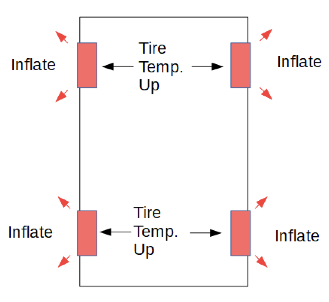
The critical challenge encountered by the STPMS algorithm in the development process is the problem of thermal expansion of tires when running. If the thermal expansion value of the tire cannot be accurately calculated, STPMS will not be able to accurately calculate the under-pressure value of the tire, and thus the tire cannot be made correctly. Pressure alarms may even cause false alarms.
After our research on this issue, we developed an original method using GNSS data,Thermal Tire Model Algorithm, can accurately calculate the expansion value of the tire due to the heat generated by running, and solve the problem of being unable to accurately issue an under-pressure alarm due to the thermal expansion of the tire due to running.
To know the importance of the hot tire model, just look at the following actual data: when the car reaches the hot tire equilibrium while walking at a speed of about 60 kilometers per hour, the expansion value produced is about 2% of the wheel diameter, and Tire deflation and underpressure 20% only reduces the wheel diameter by about two thousandths, a difference of ten times. To accurately calculate the tire underpressure value, an accurate hot tire model is required.
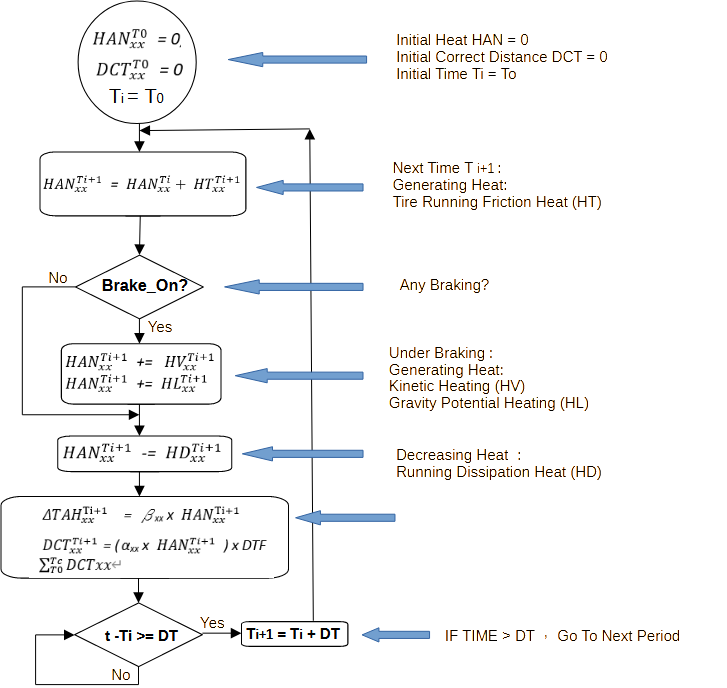
The left side is the operation process, and the right side is the description of each step. where time is represented by T0Start, the time till now is Tc, each time period is Ti, each time interval is DT, and the current time is t. In each period of time, the net heat HAN of the tire at that time is obtained, and then the travel distance shortening correction amount DCT of the tire is calculated from the net heat, where αxxSpecify the expansion coefficient for the tire, βxxSpecify the inverse specific heat for the tire, AS is the accumulated system net thermal heat, and DTF is the constant coefficient that converts the increase in the tire outer diameter into the shortening of the travel distance.


