Innovative technology and operating principles of STPMS, key contents
STPMS Innovative Technology
Integrated with GNSS, no need to install tire pressure sensor TPMS
Pure algorithm to monitor tire pressure
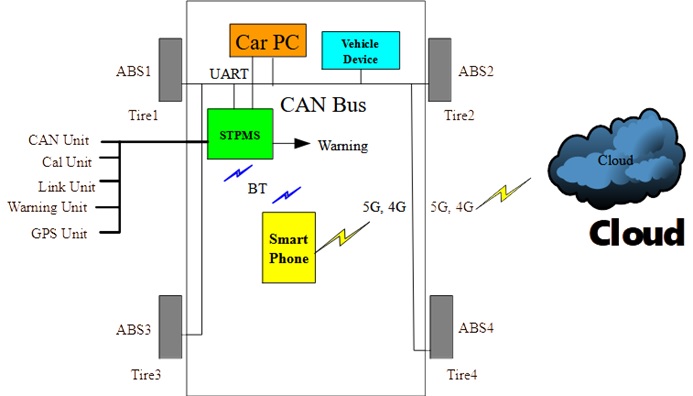
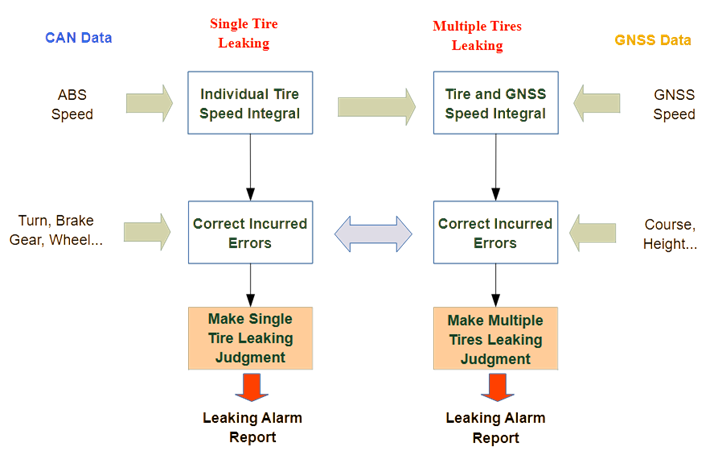
STPMS reads the vehicle's CAN data (mainly ABS) and GNSS data to perform calculations and monitor tire pressure conditions.
The ABS data is the wheel speed. When the tire is leaking, the wheel speed becomes faster. The STPMS algorithm can detect this state and issue an alarm when the under-pressure is greater than the national standard value.
GNSS data is mainly used to detect the situation when four wheels are leaking simultaneously, and correct relevant data in the algorithm to achieve high-precision goals.
Read vehicle ABS and GNSS data calculations
ABS tire speed data is read in real time by STPMS (rate is about 100Hz), and integral calculation is performed. During the calculation process, relevant data (such as Gear, Brake, Wheel) are also read in real time for correction calculation, and the single wheel is monitored by the calculation result. Undervoltage condition.
At the same time, STPMS reads GNSS data in real time, provides algorithms for more accurate calculation corrections, and monitors multiple rounds of undervoltage status based on the calculation results.
The basic operating principle is that when under-inflated, the tire speed will increase.
STPMS Technical Advantages
The technological innovation of STPMS is far superior to traditional TPMS
Indirect TPMS saves a lot of costs
Direct TPMS requires the installation of a tire pressure detector, while indirect TPMS does not require the installation of a tire pressure detector.
Direct TPMS requires installing tire pressure detectors on four tires and wirelessly transmits the detected tire pressure to the hollow host, which includes hardware costs and installation costs.
Indirect TPMS uses an algorithm to monitor tire pressure, without the need to install a tire pressure detector, and there is no hardware cost and installation cost.
Direct TPMS directly measures tire pressure and has higher detection accuracy, while indirect TPMS uses an algorithm to monitor tire pressure and has lower accuracy.
STPMS continues to optimize and improve performance, and the detection accuracy is gradually approaching that of direct TPMS.
STPMS is the preferred solution for iTPMS
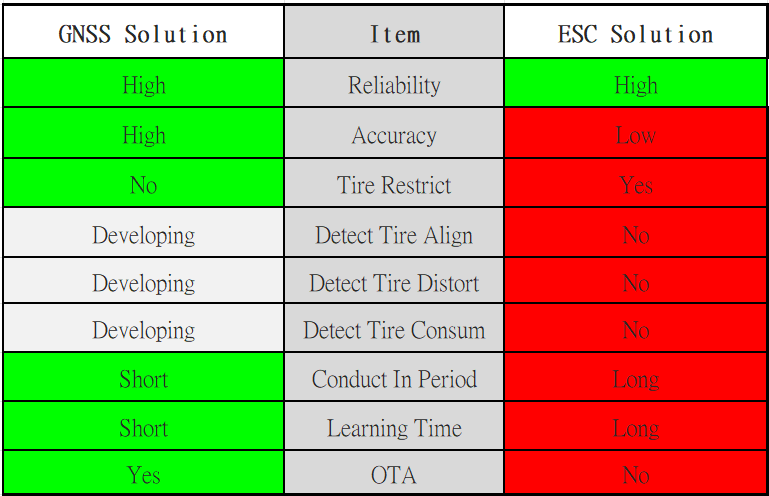
Indirect TPMS solutions can be divided into ESC technical solutions and STPMS technical solutions.
The ESC technical solution is to integrate the computing unit into the ESC system and use ESC-related data to calculate and monitor tire pressure.
The STPMS technical solution integrates the computing unit and the GNSS chip, using CAN data and GNSS data to calculate and monitor tire pressure.
In addition to high accuracy, the STPMS solution can detect other tire conditions, which is significantly better than the ESC solution.
Future Trend: iTPMS will become mainstream,
STPMS will be the protagonist
STPMS Thermal Tire Model Calculation Technology
Key technologies for high precision of STPMS
Accurate thermal tire model and optimization of related parameters
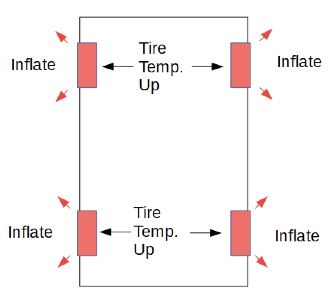
The tire temperature will increase due to the heat generated by the friction between the tire and the ground when the car is running..
Increase in tire temperature causes tire expansion.
The rate of tire expansion is much greater than the rate of tire contraction caused by tire deflation and underinflation..
Tire under pressure25%The proportion that causes tire shrinkage is only about0.2%, but the expansion of the car due to the heat generated by walking friction can be as high as 2.0%above.
Without an accurate hot tire model for correction, it is impossible to accurately measure the tire under-pressure value..
The STPMS algorithm makes good use of GNSS data and develops a very accurate thermal tire model (Tire Thermal Dynamics), to accurately measure the under-pressure value of tires.